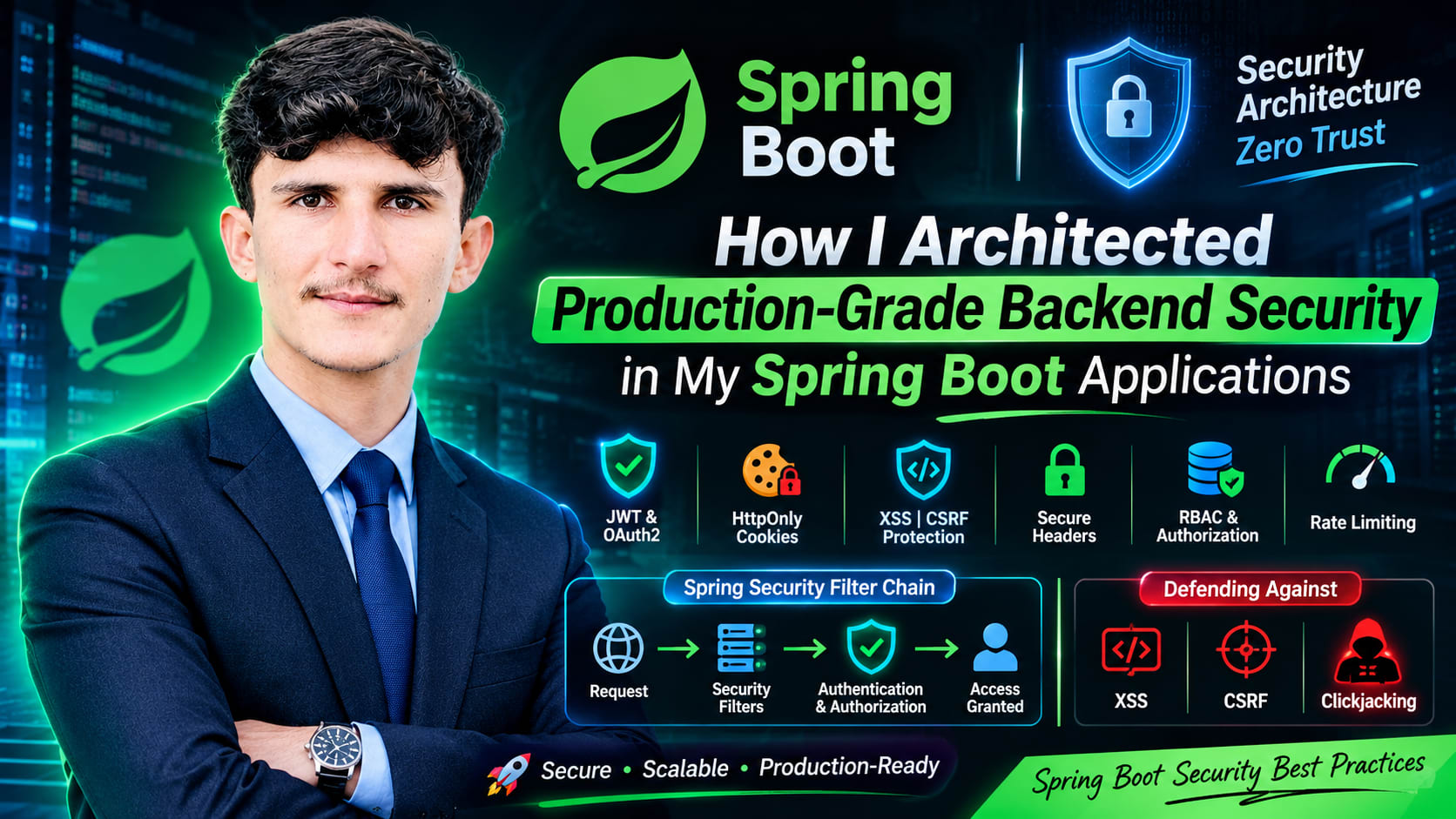
How I Architected Production-Grade Backend Security in My Spring Boot Applications
Author: Muhammad Shahis Khan
Stack: Java, Spring Boot, Spring Security, JWT, PostgreSQL, Docker
Focus: Backend Engineering, Threat Modeling, Defensive Architecture
When building a backend service, writing clean controllers and repositories is only half the job. As I designed and secured my Spring Boot applications, I realized that security isn't just a configuration checkbox—it's a mindset of threat modeling.
If a recruiter or technical interviewer asks me how I protect my APIs against modern web attacks, I don't just quote textbook definitions. Here is the exact architectural blueprint of how I handle HTTP headers, state management, token storage, and defense-in-depth in my systems.
🌐 1. Demystifying HTTP Headers and Protocol Essentials
A lot of developers take HTTP headers for granted, but when I look at a request, I see a contract between client and server.
- ⚙️ Protocol-Level Reality: The
Host header isn't optional; HTTP/1.1 demands it, and frameworks rely on it to route traffic correctly.
- 🛡️ The Defensive Layer: Beyond standard data transfer, I rely on response headers to dictate browser behavior and lock down client-side execution contexts:
Content-Security-Policy (CSP) — Restricts execution sources to prevent inline script injection.X-Frame-Options — Prevents UI redressing and clickjacking attacks.CORS Control — Manages cross-origin access and preflight OPTIONS requests.
🔑 2. My Authentication Strategy: The Hybrid Token Model
When it came to choosing between traditional server-side sessions and stateless JWTs, I wanted the scalability of JWTs without compromising security. But I quickly learned that storing tokens blindly in LocalStorage is a security anti-pattern.
Here is how I implemented a robust Hybrid Dual-Token Architecture:
| Token Type | Lifespan | Storage Location | Transmission Method | Primary Purpose |
|---|
| Access Token | Short (5–15 mins) | Frontend Memory (State) | Authorization: Bearer <token> | Authenticates active API requests. |
| Refresh Token | Long (7–30 days) | HttpOnly Cookie | Automatic via Browser | Generates new access tokens securely. |
Why This Combination Works:
- XSS Defense: Because the refresh token is locked inside an
HttpOnly, Secure, and SameSite=Strict cookie, JavaScript (document.cookie or LocalStorage) cannot read or steal it, neutralizing XSS token exfiltration.
- Blast Radius Reduction: If an access token is intercepted from memory, it expires quickly, minimizing potential damage.
⚡ 3. Defending Against the Big Three: XSS, CSRF, and Clickjacking
During my security audits, I realized that developers often get confused between attack vectors. Here is how I isolate and defeat them:
💉 XSS (Cross-Site Scripting)
- The Threat: Malicious JavaScript injected via un-sanitized inputs (like comment sections) executes inside the victim's browser, stealing session tokens.
- My Defense: Strict input validation, data sanitization, and deploying a robust Content Security Policy (CSP) to block unauthorized script sources.
🔄 CSRF (Cross-Site Request Forgery)
- The Cookie Trap: Many tutorials claim that using JWTs means disabling CSRF. However, if you rely on
HttpOnly cookies for auth, browsers automatically attach them to cross-site requests.
- My Defense: Scoping cookies tightly with
SameSite=Strict and enforcing state-changing guards.
🪟 Clickjacking (UI Redressing)
- The Threat: An attacker embeds my application inside a transparent
<iframe> on a malicious site, tricking users into clicking invisible buttons.
- My Defense: Configuring Spring Security to send
X-Frame-Options: DENY or SAMEORIGIN, instructing browsers to never render the app inside external frames.
⚙️ 4. Under the Hood: Spring Boot Internals & Defensive Coding
When requests hit my Spring Boot application, they flow through a structured internal lifecycle:
1
HTTP Request ──► Security Filter Chain ──► Authentication Manager ──► JWT Validator ──► SecurityContextHolder ──► Authorized Access
- The Security Filter Chain: Incoming requests pass through security filters (
UsernamePasswordAuthenticationFilter, custom JWT filters) before populating the SecurityContextHolder.
- Role-Based Access Control (RBAC): Utilizing method-level security (
@PreAuthorize("hasRole('ADMIN')")) for precise access checks.
- SQL Injection Immunity: Using Spring Data JPA and Hibernate with Parameterized Queries (Prepared Statements). User input is strictly treated as data—never as executable SQL code.
- Double-Lock Validation: Validating payloads first at the DTO Layer (
@Valid, @NotNull) for fast-fail rejection, and reinforcing safety at the Entity/Database Layer as an unyielding safety net.
🚀 5. Production Hardening and Defense in Depth
Beyond basic code-level logic, production systems require infrastructure-level protection:
- 🌐 CORS Configuration: Explicit rules bridging frontend (
localhost:3000 or domain) and backend origins with AllowCredentials enabled.
- 🚦 Rate Limiting: Managing traffic bursts and brute-force attempts with standard headers (
X-RateLimit-Limit, X-RateLimit-Remaining, and 429 Too Many Requests).
- 🧱 WAF (Web Application Firewall): Cloud-edge filtering via Cloudflare to block bad bots and injection payloads before they ever stress my server infrastructure.
Comments 0
Guest comments are reviewed before they appear.
Loading comments…